National action · Every state and territory

NDIS CARERS ARE
STRIKING.
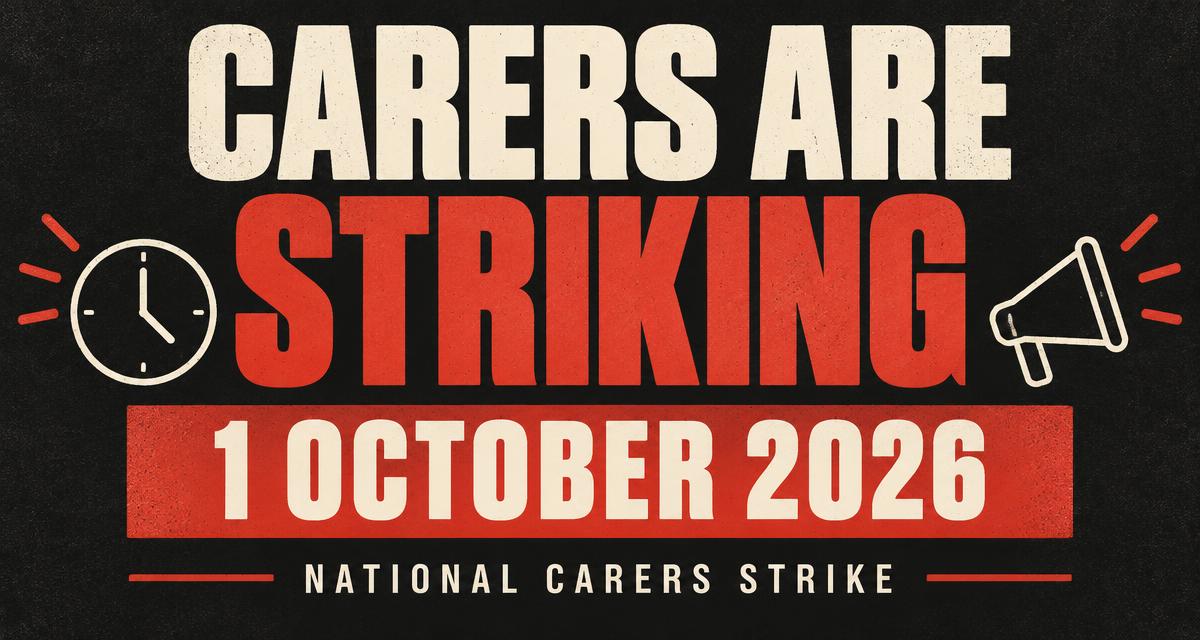
1 OCTOBER 2026.

For 24 hours from 9:00am local time, carers across every state and territory are withdrawing unpaid care labour and handing responsibility for NDIS participants back to the federal MPs whose government cut their support.

Strike begins in

00days
00hours
00minutes
00seconds

9:00am local time · 1 October 2026

0 carers, participants and supporters registered nationwide

Carers are striking on 1 October 2026 — National Carers Strike campaign poster
01

Why we’re striking

The policy calls them safeguards. The arithmetic is less reassuring.

Up to 50%

Community life, cut

From 1 October, funding for social and community participation supports is being cut by up to half. That’s the money behind community access, transport, 1:1 outings and everyday participation that keeps people connected to the world.

Personal care and daily living supports are not touched — community life is. This puts disabled people back into the dark.

$215,030

A very precise threshold

The new s47a plan variation pathway is offered only to “high support needs participants” meeting a presise 'funding' (not need) threshold of $215,030 and receiving 24-hour funded (not need) support at a shared ratio of at least 1:3.

90 +21 + 21

Months pass before funding is assessed to be reinstated or not.

The NDIA’s own process allows up to 90 days to submit the plan variation request, then 21 days to assess a plan variation request, then up to another 21 days for a decision on the plan variaton request. That's 132 days for the process in total - which is over 4 months! Participants can remain on reduced funding, with no reduction in need, for months.

Carers have been absorbing funding shortfalls unpaid for years. This strike is carers stepping back for one day so government can see what “stripped-back support” actually looks like.

Read the government’s release
02

What’s happening on 1 October

24 hours

From 9:00am local time, nationwide, at federal electorate offices.

Carers step back

Carers withdraw their unpaid labour for the day.

Care goes to government

Each participating carer delivers their NDIS participant to their own local federal MP’s electorate office, where care continues, unpaid, provided by electorate office staff.

What paid support is for

Paid support funding that participants still have is going to essential support at home. It is not being redirected to help government manage the strike.

Find your federal electorate office
03

How to take part, properly

This only works if it’s deliberate, not chaotic. This is a strike, not an ambush — the point is what the government does with clear notice, not what happens if we spring it on them.

Before you go

Duty of care starts with clear consent

  • Talk it through with the participant’s family or guardian and get their agreement.
  • Only put forward participants for whom a day in an unfamiliar office is manageable.
  • Give the electorate office a written copy of the participant’s support needs in advance, so “informal care” isn’t a mystery for whoever’s on the desk that day.

What we need from you

  1. 01

    Show up at your local federal MP’s electorate office on 1 October, or support someone who is.

  2. 02

    Bring the participant(s) you support, with their family’s informed agreement, hand them into the office, and then step back. The point only lands if government has to respond — not if we quietly stay and cover for them again.

  3. 03

    Register so organisers can coordinate numbers, timing and the support information each office will need in advance.

  4. 04

    Tell another carer. This works because there are thousands of us.

“Without carers, this entire system stops in a matter of hours. Everyone in Canberra knows it. Today, we’re letting them find out properly.”
04

Our demands

1

The National Disability Insurance Agency and Australian Government take direct responsibility — fully funded and staffed by government — for participants’ safety and support needs for the duration of the strike.

2

The cuts to social and community participation funding are reversed before further NDIS plans are affected.

The centrepiece

An Open Letter of Resignation

From a primary carer, to the Minister for Health, Disability and Ageing, and the Minister for the NDIS.

Download as PDF

Letter of Resignation

Re: Cessation of Unfunded, Unrostered, Unratio’d On-call Care Services

23 September 2026

To: The Hon Mark Butler MP – Minister for Health, Disability and Ageing, and the NDIS
Senator the Hon Jenny McAllister – Minister for the NDIS

I am writing to formally resign from my position as Primary Carer. The scope creep to Case Manager, Night Owl, Advocate, Interpreter of Jargon, Budget Ninja, Accidental Therapist, and Chief Search-and-Rescue Officer (Missing Continence Aids) is unsustainable. As you know, I have held this role for 20 years, unpaid, unbriefed and unratio'd. I submit that no exit interview is required, as you already hold several years of my feedback on file.

Notwithstanding my impending departure, I've had a chance to read (and re-read) your 22 September (yesterday) release on funding changes and safeguards, and I want to say: I admire the confidence. It takes a certain flair to reduce a vulnerable disabled person's community participation budget and call the document that explains it a 'safeguard'. I submit that's not policy writing, that's branding. Please pass my compliments to whoever workshopped that pearler in the marketing department (or whichever AI drafted it for them). The audacity deserves its own support category, though I wonder whether you'd file it under flexible Core funding, or lock it away in restrictive Capacity Building?

I note the new plan variation pathway is available to "high support needs participants" who meet a certain (suspiciously precise) funding threshold of $215,030. I also note it applies only to those receiving 24-hour funded support at a shared ratio of at least 1:3. I'd like to flag, for the record, that I've been providing support at a ratio of 1:1 for two decades, unpaid. As I am a reasonable person (and by all accounts for the last 20 years have been necessary), I am not requesting backpay (although I remain open to the possibility). It appears, however, that in providing care unpaid, I have inadvertently done my loved one a disservice — undermining the very funding and protections your safeguard document is meant to guarantee them. I am still ruminating on the observation that "other parts of the plan will not be impacted" and remain, notably, uncomforted.

I was especially moved by the worked examples you provided. On face value, I'm sure they're lovely people — albeit imaginary, and still luckier than most actual disabled people in the NDIS.

Correct me if I've misunderstood (note: I've added a little context under poetic license to assist my understanding). Daniel had his community participation budget halved. He lodged the plan variation request on day 88 (of a 90-day window). Daniel is high needs and does not have any Support Coordination funding left in the current instalment, so his plan nominee/carer had to write the s47a on their own (more free labour, more mental load) whilst, I'm assuming, the carer was concurrently caring for Daniel in the hours where his funding had been cut (the reason for the s47a — ironic much?). Marching on, the NDIA took 21 days to assess the s47a (I reckon they're going to be busy with these, so they've allowed them the maximum timeframe you mentioned), then — oh my gosh — another 21 days for a decision. Phew, what a marathon. Ultimately, after 130 days (a squeak over 4 months) on reduced funding (with no reduction in need), Daniel's plan was handed back to him with funding for a third of what he lost. The add back was calculated by how many hours Daniel would now be spending at home at a lower support ratio than when he was in the community (I see what you did there). Is this another bit of genius marketing spin, where you lock away disabled people in their houses with less support ratio/oversight and call it a Safeguard? This sounds like Uber surge pricing, but in reverse: is the hypothesis that the less Daniel can do, the cheaper he becomes to support. Am I wrong?

I can't quite wrap my head around the example of Amina, who, it appears, was assessed, found 'eligible-adjacent' (you can borrow that new term if you like — you're going to need it), and yet declined for a s47a, because the math said she was both essentially "not enough" and "fine" at the same time — impressive multitasking from a spreadsheet with a marketing degree. That algorithm's really earning its subscription fee this week.

Now back to my original reason for writing to you today. As enticing as the offer is for me to continue in my present role and expand on the scope (yet again), I respectfully decline.

Thus, I tender my resignation with a reasonable 7 calendar days' notice, effective 1 October 2026, to align with the change date you've proposed, and so we don't get into a kerfuffle. I appreciate this notice period may be problematic; however, I don't recall a notice period being specified in your assumed agreement for my voluntary, unpaid, informal care — so I've self-assessed that 7 days represents value for money (for you): effective (for me), albeit not beneficial to my loved one. I trust the Department will find this easy to absorb, given how comfortably it has already absorbed the difference between "reasonable and necessary" and "reasonable and necessary, within a budget."

I won't be available for handover. There isn't one. That was rather the point of me in this role. I thank you for the opportunity over the last 20 years — it's taught me a great deal, mostly about spreadsheets, support ratios, and the outer limits of my own patience.

With the composure of someone who has read the Intensive Pathway Safeguard document more times than the person who wrote it (or whoever proofread what the AI drafted),

sincerely,
A Carer

This letter is satire, written by a carer, and reflects one carer’s experience. Names in the examples are illustrative.
05

Take action

One day. One clear point. Choose how you’ll stand with it.

0 carers, participants and supporters registered nationwide

Register

Strike or support

Help The National Carers Strike organising committee coordinate numbers, timing and office information.

We collect only these details to coordinate the action. Never personal health or diagnosis information.

Share

Tell another carer

06

Questions, answered plainly

What is the National Carers Strike?

A 24-hour nationwide withdrawal of unpaid care labour from 9:00am local time on 1 October 2026. Participating carers will take NDIS participants, with informed agreement and advance notice, to their local federal MP’s electorate office.

Why are carers striking on 1 October 2026?

That is the date the government’s funding changes take effect. Carers have covered shortfalls unpaid for years; for one day, government will be asked to manage the practical result itself.

What NDIS funding cuts start 1 October 2026?

Funding for social and community participation supports is being cut by up to half. This is the money behind community access, transport, one-on-one outings and everyday participation; personal care and daily living supports are not touched.

How can I support the National Carers Strike?

Register as a carer, participant, family member or supporter. You can also contact your MP, share the campaign and help someone participate safely and with informed agreement.